
Cultural Mapping by
Heritage Management Programme Year 4


Playground for Everyone
Public space is a realm that people, through verbal and behavioural activities to express themselves, and it coordinates people’s actions. -- Hannah Arendt
The existence of public space gives people the opportunity to interact with each other and organise various activities. As a branch of public space, the Playground (public sports space) plays a pivotal role in people’s daily routine, strengthening the body and expanding social interactions. While people enjoy the physical and mental satisfaction brought by public sports spaces, the public sports spaces also function as community adhesive, enhancing people’s social identity and constructing the sense of community. As for Macao, the large population needs to be accommodated with the city’s boundaries, which leads to the land shortage. Within the context of the market economy, relatively low economic effects of public sports space face fierce competition of alternative mode of land use. As a consequence, the existence of public sports spaces reflects their preciousness. We will illustrate the history and significance of “Playground for everyone” using three different public sports spaces.


Estoril Swimming Pool
Estoril Swimming Pool is the first modern swimming pool in Macao, which opened in June 1952. Also, the pool is the longest existing public swimming pool. Due to the lack of public spaces in the past, the pool also has other uses than swimming, such as the glasshouse for table tennis built in 1953 and Kung Fu combat between Ng Gong Yee and Chan Hak Fuat at the pool in 1954, which regarded as a major event among martial arts circles, the pool then became a collective memory of people.
The pool is a complex built structure of the main building and staircases, and the main building is classified as Soft Portuguese Style, widely used in Portugal in the mid-20th century. From the aesthetic perceptive, clean and simple architectural design emphasises the horizontality embodies the characteristics of modernism. White columns support the public grandstand area, and it is a feature of southern European architecture’s response to climate.
Nowadays, Estoril Swimming Pool is the only representative of Soft Portuguese Styles under the category of public built structures. The garden-style space plan made Estoril Swimming Pool the most beautiful public sports spaces in Macao in the 20th century.
The architectural and social significance give Estoril Swimming Pool a new connotation. It has long exceeded the definition of public sports spaces, becoming a public space in the emotional sense of Macao people.
References:
Botas, J. (1970, January 1). Combate de Kung Fu na Piscina Municipal (1954). http://macauantigo.blogspot.com/2014/05/combate-de-kung-fu-na-piscina-municipal.html.
陳樹榮. (2014). 《澳門記憶》(一). 澳門 : 君亮堂.
故城.回憶. (2014). 愛都酒店遺址與新花園游泳池:第三代賭王立足之地(上). https://memorymacau.blogspot.com/2014/02/blog-post_7.html.
呂澤強. (2018). 澳門葡萄牙風格建築. 澳門葡萄牙風格建築 - 澳門雜誌. http://www.macauzine.net/?action-viewnews-itemid-1205.
Macau Lifestyle. (n.d.). Estoril Swimming Pool. Macau Lifestyle. https://macaulifestyle.com/city-guide/estoril-swimming-pool/.
Root 我城社區規劃合作社. (2015). 新花園市政泳池的建築特色. Facebook. from https://www.facebook.com/RootPlanning/photos/491729154323079/.
Soft Portuguese style. (2020). Soft Portuguese style. Wikipedia. https://en.wikipedia.org/wiki/Soft_Portuguese_style.

Tap Seac Square
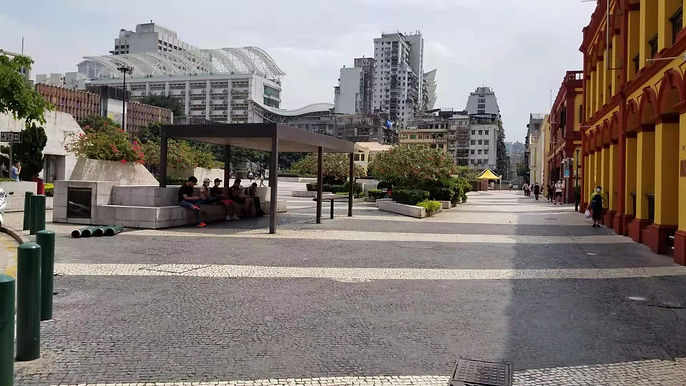
Tap Seac Square located in St. Lazarus Parish, which is the largest square in Macao and was originally the Tap Seac Sports Ground. Tap Seac Sports Ground was built in 1923. Many Macao people used to play hockey and football matches on this grassland. Later, Tap Seac Sports Ground kept changing. In May 2005, Sports Ground was demolished during the project, and the section of Conselheiro Ferreira de Almeida from the Cultural Institute of Macao to Tap Seac Gallery was integrated into a part of the square. There is a carriageway underground and it was officially opened to traffic on July 22, 2007.
The predecessor of Tap Seac Square was one of the earliest sports grounds built in Macao. It was once the Sports Ground where athletes gathered. Tap Seac Sports Ground has a long history, and its name has been changed many times. In 1842, the Hong Kong Jockey Club used this sports field for horse racing; until 1904, it was named "Mesquita Sports Field" and "Tap Seac Wave Land". The so-called "Tap Seac", formerly known as "Stacked Rock", was because of the location. The granite rock has this name because of its strange shape. Moreover, because the Portuguese in Australia like to play hockey here, it was once called the "hockey field", and because it is close to the nearby Liceu school, it is also called the "Liceu Field". ; Building of the Former Caixa Escolar was completed in 1925, and it was also named "Caixa Escolar Field"; and more than ten years ago, Liceu School was relocated, and this Sports Ground was renamed "Tap Seac Sports Ground" because it was located in Tap Seac. . In the 1960s, basketball courts were built in the stadium, so more and more locals came to play here, which became a collective memory of Macao people.
Tap Seac Square has now become a venue for large-scale events in Macao. In July 2008, the government launched the "Tap Seac Craft Market" brand event for the local cultural and creative industries to showcase their style and encourage those who love hand-made crafts to create more art. It is an exquisite product, and many performing groups are invited to perform to add to the excitement. To create a cultural and artistic atmosphere in Macao and promote the development of cultural industries.
References:
A01頭條. (2005, May 10). 塔石球場今拆建廣場 原藉用上體育課學校受影響.
澳門日報. (2007, July 23). 議員: 經濟效益 交通配套堪關注.
林發欽. (2004). 澳門街道的故事. 澳門: 澳門培道中學歷史學會.
周凡夫. (2005, July 30). 利宵變塔石曲棍添藍球歷盡滄桑球場改廣場舊貌換新顏難言好壞.
濠江客. (2005, April 12). 塔石球場名字多.
劉國生. (2011). 塔石藝墟推動創意產業. doi:http://www.macauzine.net/?action-viewnews-itemid-144
陳樹榮 . (2014). 澳門記憶(一). 澳門: 君亮堂.
澳門特別行政區民政總署. (1950). Retrieved from http://www.mam.gov.mo/oldmam/photodetail.asp?productkey=2009030601002&lc=1


Nam Van Lake
Nam Van Lake, located in the south of the Macao Peninsula, is also called Nam Van Artificial Lake because it is not a natural lake, but is made by embankment. It is the largest artificial lake in Macao. Nam Van Lake was once a bay in the south of the Macao Peninsula called Nam Van, which was the main commercial center of Macao in the past.
Centro Náutico da Praia Grande was completed and opened on 18 July 2005. Covering a total area of about 151,000 square meters, the onshore facilities cover an area of about 11,708 square meters, complete with supporting facilities. The center is not only the venue for the international dragon boat invitational race, but also the training venue for water sports athletes, as well as the venue for local cultural activities and carnival activities, as well as a good place for citizens to enjoy themselves.
The onshore facilities provide 800 seats and areas for the construction of over 2,500 temporary seats. There are also preparation areas for athletes, preparation areas for dragon boats, a boat dock with adjustable water level, a boat storage and changing rooms. The lake floor is used by the public for morning sports.
References:
Hong, H. W. (1994). O Passado de Macau - Colecção de Bilhetes Postais. Macau Foundation.
澳門特別行政區政府體育局. (2021). 南灣湖水上活動中心. Retrieved 05 5月 from https://www.sport.gov.mo/zh/vbs/searchvenue/type/show/id/12
陳樹榮. (2014). 澳門記憶(一). 君亮堂出版社.
