
Cultural Mapping by
Heritage Management Programme Year 4


Born for Speed
Racing means the competition of speed. From running race to car race, human has never stopped the pursuit of speed. Talking about the game in Macau, although glamourous casinos may come to mind first, racing games are never absent from people’s gossip. Marathon, Grand Prix, horse racing are all popular in Macau. Some of these involve gambling while others are not, but they have one thing in common: the passion and excitement they brought to the audience. The development of racing games and the usage change of their venues can reflect the change of Macau city to a certain extent. In this theme, Yat Yuen Canidrome, Macau Jockey Club and Guia Circuit are chosen to tell the stories between racing games and Macau from dog racing, horse racing, and car racing.

Yat Yuen Canidrome
Located at the foot of Mong-Ha Hill, Yat Yuen Canidrome started its business in 1963. Back in 1932, the very first dog racing in Macau also happened here. Dog racing originated from the coursing game from Europe, and it developed into a well-welcomed gambling racing game in the USA in the early 20th. In 1931, dog racing in Shanghai was forbidden by the government, and the dog racing company tried to move the business to Macau. With the support of Macau government, the Macau dog racing club was established and got the license. A canidrome was then built near Mong-Ha Hill, and it opened on next year’s eve. However, it closed due to bad management. It changed hands several time. In 1940, the government took it back and rebuilt it into Ling Fong Sports Field.
In 1961, the government agreed to hold dog racing again at the same location. Ho Yin, the local business leader, got the licence two years later and started the first race of Yat Yuen Canidrome. This new canidrome had a 350-meter sand track. Greyhounds purchased from Australia raced after the lure. The audience could watch the game or make a bet at the spectator stand, and there is a huge scoreboard on the other side of the track. Dog racing usually started after 8:00 pm. With its cheap tickets, it soon became a popular entertainment for Macau common people, also attracted many visitors and gamblers from Hong Kong and mainland China.
The canidrome made the most revenue from 2009-2011. However, with Macau’s gambling industry development, canidrome was less attractive than the newly built casinos. There were also many critics from animal protection organizations on the treatments on the greyhounds. In 2018, Yat Yuen Canidrome held its last game, the venue was handed over to the government then. The greyhounds were open for adoption. Now, all facilities related to dog racing are shut down, except the Ling Fong Sports Field, which continued to be used by the public. The last legal canidrome in Asia has now become a collective memory of Macao people
References:
新生代. (2018). 狗場風霜雨露八十載. 新生代: https://ngplusmedia.com/feature-canidrome-history/
叶靖斯. (2018). 澳門逸園赛狗谢幕:一场圍繞格力犬的領養“爭奪戰”. BBC中文: https://www.bbc.com/zhongwen/simp/chinese-news-44652836
馬有史. (2019). 淺談澳門賽犬的由來與終結. 馬有史: https://horsehavehistory.medium.com/淺談澳門賽犬的由來與終結-7f11b53b00b2
趙利峰. (2013). 民國時期的澳門跑狗事業. 澳門研究.


Macau Jockey Club
Horse racing is legal gaming activities in Macao. According to the definition in MSAR Law No. 16/2001, horse racing is categorised as pari-mutuels.
The history of horse racing in Macao can be trailed back to 1842. After the Opium War, the British ruled Hong Kong under the Treaty of Nanking. However, at the beginning of Hong Kong, although the British were eager to hold horse racing activities in Hong Kong, they could not find an ideal venue to hold the race. As a result, the British asked for Macao place to hold the race. According to the research, the racecourse held in 1842 was located between Tap Seac Village and Long Tin Village, which were located in today's land between Tap Seac Square and Estrada de Adolfo Loureiro. Therefore, the British horse racing in Macao in 1842 was generally recognized as the beginning of horse racing in Macao by the historians of Hong Kong and Macao.
At present, the companies specializing in horse racing are respectively Macau Jockey Club Ltd. (MJC). Macau Jockey Club was formerly the Macau Trotting Club, changed ownership and became the Macau Jockey Club for flat racing in 1989. Its first flat race held on September 10, 1989. The Macau Jockey Club acquired by a consortium led by Dr Stanley Ho in 1991.
The Macau Jockey Club runs has races all year round, and racing Season starts from September to the end of August in the following year. Moreover, every week there are two days of competition, every Friday night meeting, and Saturday or Sunday day meeting or twilight meeting. The Macau Jockey Club will be also broadcast the horse racing of Hong Kong, South Africa, Singapore, Malaysia and Australia.
References:
Macau Jockey Club. (2011). About Mjc. Retrieved 4 May from http://www.mjc.mo/race_en/info/i_pages.php?id=83
澳門特別行政區政府新聞局. (2020). 澳門年鑒 (2020 年 9 月 ed.). 澳門特別行政區政府新聞局.
黃健威. (2016). 馬場大馬路與澳門早期賽馬活動. 澳門雜誌, 113, 78-83.

Guia Circuit
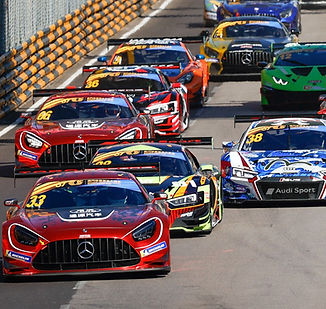
The Macau Grand Prix first run in November 1954. At that time, the Macau Grand Prix was just a club race organized by local motoring enthusiasts. The Macau Grand Prix has been held for 60 years. It has now evolved into Macau's largest annual sports and tourism event, and it can be one of the Macau's largest international event. The Macau Grand Prix is held on the third week of November every year, and it can attract a large number of racing fans to attend the race. During the preliminaries and the racing period, there is an endless stream of tourists, and the city is full of excitement and excitement. The atmosphere, the roar of engines on the street one after another, and the colorful advertising flags flutter. During the Grand Prix, the pace of life in the city seemed to be speeding up with the speed of the car.
The Grand Prix includes six races including "Formula 3", "FIA World Touring Car Championship", "Macao Grand Prix Motorcycle", "Macau GT Cup" and "China Motorsports Grand Prix".
The Guia Raceway surrounds the Guia Mountain in Macau. The track is 6.2 kilometers long. The widest runway is located at the start/end point maximum width with fourteen meters. The narrowest run is the Melco Hairpin minimum width only seven meters. A street circuit with an exhilarating combination of long, fast straights and sharply twisting corners. It is recognized as one of the most demanding circuits in the world. It was once selected as one of the "Ten Most Exciting Streets Race " and "Twenty top racing events can't miss".
References:
Sports Bureau of Macao SAR Government. (2021). Macau Grand Prix. Retrieved 4 May from https://www.macau.grandprix.gov.mo/en/

